


The leopard (Panthera pardus pardus) is an elusive, solitary big cat and member of the Big 5, found throughout sub-Saharan Africa.
Known to be exceptional at adapting to almost any environment, and being excellent climbers, leopards can conquer almost any habitat. As a result, leopards are one of the most successful big cat species in modern history.
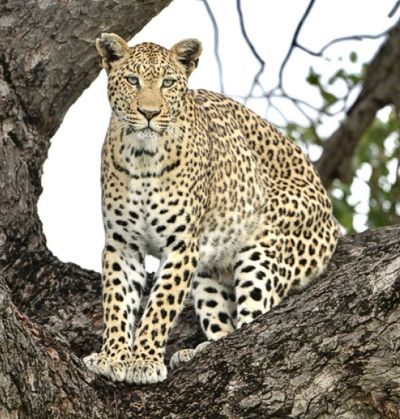
Having adapted to inter-specific competition by hoisting kills into trees, and escaping attacks by climbing, when needed, leopards have adapted this integral lifestyle for their success in the wild - one that is crucial for outcompeting scavengers and other predators!
African leopards are genetically different to Cape leopards. However, their physical characteristics are surprisingly similar: tawny-to-golden brown fur, spotted with markings known as rosettes down the length of the body, and a heavy, robust frame. The robust tail ends in a flurry of white fur, spotted with black spots, and forms an important part of a leopard’s prowess and ability to balance. The biggest difference between the two is size: African leopards are substantially larger, with large males weighing up to 80-90kg, and standing at an impressive 70cm tall - while adult Cape leopards are approximately half of that weight.
Did you know?
- Although leopards are said to be the most successful of the big cats globally, with nine recognised subspecies native to 35 countries, leopards still face major threats, with habitat loss, poaching and human-wildlife conflict being the top three. African leopards are classified as “Vulnerable”, but despite habitat fragmentation, persecution, poaching and more, leopards use their adaptability and impressive resilience to survive - even in the harshest of conditions..
- The African leopard is the most widespread of all leopard subspecies, and the Cape leopard is simply a genetically distinct and adapted population of the African leopard. Interestingly, Cape leopards are also classified as Panthera pardus pardus - the same scientific name! They have simply been isolated to a small region of the coastline of South Africa for so long that they have genetically and physically adapted to the different, and very specific, habitats and ecosystems found there. They are named after the mountainous Western Cape, where they are predominantly found.
Fun Facts:
- The density of leopards is dependent on many factors, including food availability, competition, and habitat availability. Southern Africa has the highest leopard density in Africa, largely due to the vast habitat availability in the various protected areas and surrounds.
- Also, if other predators are not in high densities in an area, leopards will not hoist kills in trees, as there is no need to. Less lions and spotted hyenas reduce the need to spend this energy!
Words by Tess Woollgar. Images courtesy of Craig McCann