


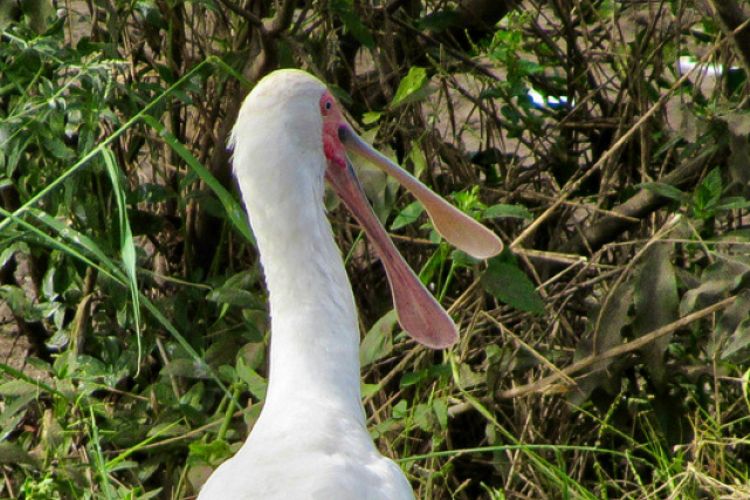
This beautiful bird (Platalea alba) is one of the most popular and unusual waders.
Seen regularly throughout the month, this distinctive bird is characterised by its flattened and decurved, spoon-shaped bill, white body, and pinkish-red legs, face and bill.
Being quite large, at between 75-90cm in height, this bird is not easily overlooked. This species is known to be quite shy and is most commonly seen fishing in shallow pools of water. Their diet consists mainly of small fish and aquatic invertebrates, such as crabs, molluscs, and insects.
To feed, spoonbills walk slowly in the shallows, with the bill open and submerged in the water, swaying the bill from side to side. This allows any fish or aquatic invertebrates that pass through the bill to be captured in the spoon and quickly swallowed by means of a “head jerk” - where the bird will suddenly toss the head backwards, tossing the prey into the mouth to be swallowed.
Did you know?
- Young spoonbill chicks do not resemble adults and lack the spoon-shaped bill! They hatch with a very short, stumpy beak, which develops over time to look more like a spoon. By the time the chick is almost fledging, the bill resembles a spoon, and flattens, becomes decurved, and elongates more over time until the adult spoon-shaped bill is evident.
- The flattened spoon shape of the bill likely developed in response to their feeding technique of fishing with the bill open in the water. The flattened and widened surface area available acts as a more efficient “trap” for catching fish, giving more available surface area when the beak snaps shut when movement is detected. The spoonbill will also eat molluscs and crabs, which can also be more easily gripped and captured with this bill shape.
Fun Fact:
- African Spoonbills have been known to forage with other animals. They can be found in amongst groups of other waders, such as herons, storks and egrets, where they capitalise on meals that have been disturbed by the other birds fishing. However, two of the more surprising species they benefit from are hippos and crocodiles! When these larger animals move through the water, they disturb may smaller animals - most of which are considered prey to the spoonbill. It is, therefore, not uncommon to see these birds following hippos and crocodiles around in shallow pools of water.
- Although they are mostly known for wading, these birds have also been known to actively chase prey at speed, dig directly into mud to find food, or even feed on locusts on land!.
Words by Tess Woollgar. Images courtesy of Aimee Langenhoven.