


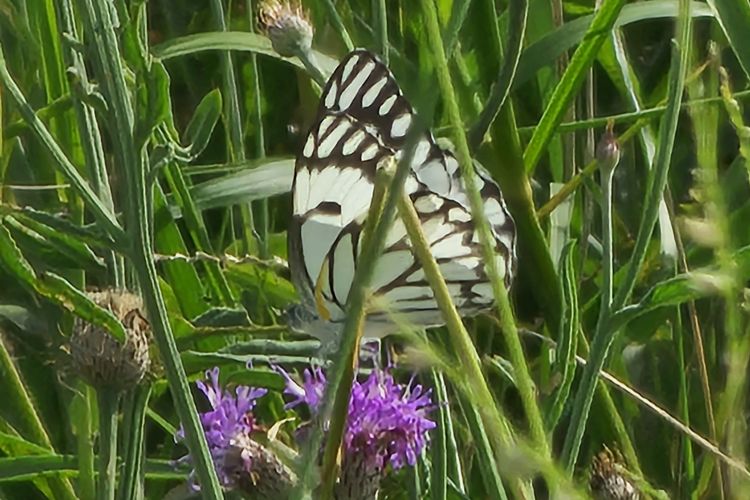
Did you notice hundreds of of these butterflies at Ingwelala over the past two months?
The Brown-veined White butterfly (Belenois aurota), also known as the Pioneer White or Caper White butterfly, is a white, medium-sized butterfly with thin, brown veins on the wings and dark wingtips. Most notably seen from November to February, this butterfly commonly occurs in arid areas in Africa and South Asia and causes quite the spectacle when moving en masse across the interior of the country during their annual dispersal. During this time, hundreds of thousands of these butterflies take to the skies and move in a straight line towards the east.
It is important to note that although it may look like a migration, these butterflies do not actually migrate. A migration is a long-distance, seasonal movement which historically correlates to breeding sites and non-breeding sites. It is like a round-trip: a journey with a return ticket. Migrations are common in bird species such as European Rollers, and in animals like Blue Wildebeest and historically even elephants. These animals will follow the seasonal changes to find better food, environmental conditions or breeding sites, a process which is repeated cyclically by each individual and generally the animals return to the original area.
What we are actually seeing with these butterflies is a dispersal: a one-way short-distance movement to a different area, which is non-cyclical (it has no return ticket). This is usually done to avoid competition or to regulate population densities, not to find breeding sites or “better” environmental conditions (as would occur during a migration). Because insects have a very short lifespan in their adult stages, insects would likely not survive a true migration period of any great significance - it would simply take longer than they can live to make the trip and return safely. Regardless, most insects can survive colder temperatures during their pupal stage and would therefore not need to migrate. The most well-known exception is the African Monarch butterfly (Danaus chrysippus), which is the only butterfly species in the world that is known to make a two-way migration, like birds do. The average lifespan of a butterfly is varied between only a few days and a few months, depending on the species, with most adult butterflies living for only a period of maybe two weeks!
This delicate butterfly species has frequented Ingwelala over the past two months during their dispersal period. This dispersal towards the north-east usually occurs during our wet season and should happen yearly. Interestingly, these butterflies were only noted in large numbers at Ingwelala towards the end of January, which continued through the month February. This is a bit “late” but considering that the rainfall was also delayed this season these two factors are likely linked as it is believed that rainfall is what triggers the mass movement or dispersal.
The Brown-veined White butterfly is most noticeable during its adult phase when it is a butterfly fluttering along in the bush. It goes through the same life cycle as any other butterfly would, and some of the phases can be very tricky to spot with the naked eye. This is what the life cycle of a butterfly looks like:
In the life cycle of the butterfly, each phase is unique and serves an important purpose, and there are various crucial elements for each phase of the cycle to complete successfully:
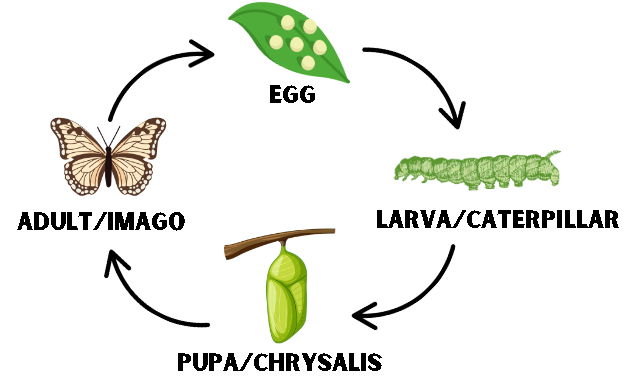
- Butterfly eggs must be laid in the correct environmental conditions and preferably on or near a certain host plant species’ leaf, which will act as a food source. This means that adequate rainfall is important to ensure the plants have green leaves and the temperature is appropriate for the incubation of the eggs. If temperatures are too cold, they will not incubate or develop. If it is too hot, the eggs will overheat, and the larvae may die.
- The larvae, when they hatch, are tiny and need enough food to grow rapidly. This phase is when the butterfly’s life cycle is the most aggressive in terms of feeding, as the larvae require adequate green leaf matter to grow and begin pupation, requiring them to feed voraciously and shed or moult their skin multiple times to grow larger.
- During pupation, a change is happening where the larva (caterpillar) is metamorphosing into the adult butterfly inside of a hard protective casing (the chrysalis). During this phase, the body of the caterpillar changes to form the adult features of the butterfly. Temperature is also quite important during this phase.
- Once all changes are complete, the adult butterfly emerges from the chrysalis. This is usually the shortest phase of the life cycle, and the primary goal is to mate and reproduce. Males and females will find each other, occasionally feeding on nectar and pollen in between (and acting as important pollinators), and then the cycle begins again as the eggs are laid on a host plant.
Throughout this process, environmental conditions must be appropriate for each phase of the life cycle, and as such act as triggers for the life cycle. Female butterflies are generally considered as the “carriers” of the population, as where and when they lay their eggs will influence the general population dynamics and distribution, and whether the population increases, decreases or stays roughly the same. As such they form a crucial part of research operations, especially when studying phenomena such as the dispersal of this species.
Research is ongoing on this incredible species, but it is widely accepted that we actually don’t know what is happening with these large-scale dispersals, or where exactly the adult butterflies end up. Moreover, from a scientific perspective, because so little is known about this dispersal and this species with certainty, there is more misinformation than accurate information, and as such it is very tricky to ascertain what is true and what is false. In general, it is believed within the entomological and lepidopterist (butterfly) communities that this is one of the most factually incorrect and misunderstood phenomena in the world!
What is known from research is that most of these dispersals happen from west to east and usually follow on from good rains in the Kalahari region. We know their favourite host plant seems to be the Shepherd’s tree (Boscia albitrunca), but this is also dependent on geographical location. Overall, it is probably a factor that this dispersal is likely to assist with the dispersal of eggs, and therefore the population, over a larger area. By pausing along their route to periodically lay eggs, they would achieve a wider distribution and more evenly spread-out densities across larger areas. However, more research is needed on this species.
This butterfly species has been a wonderful reminder of the varied perspectives on topics such as these. Conversations about this butterfly in recent months have been plentiful, energetic and fascinating, and invaluable in the sense that they have highlighted that we truly don’t know enough about this species or their mass dispersal. Within every conversation had amongst the local community, “new” and different information was brought to light in some way or another, highlighting just how much confusion there actually is! In this case, it is a situation where we gather bits and pieces of information from the internet, conversations, expert opinions and books, and we end up with a mix of information that we each make sense of in our own way. It has sparked a fair number of debates as well, and it has been refreshing to put the focus on something so “different” from the usual conversations in the bush.
In reality, and on a serious note, we do not actually know exactly what triggers the phenomenon of this immense dispersal, but researchers believe they are getting close to the truth. What has also become apparent is that changes in rainfall and temperature patterns are affecting these large-scale dispersals, which in turn will affect many other species and ecosystems. Climate change has already affected global temperatures and weather patterns, and the smallest change in temperatures or rainfall could have a massive influence on when these dispersals begin, how they are carried out or even the overall direction of movement.
Considering the immense scale of such a dispersal, these butterflies play a crucial role in the ecosystem, whether by pollination of flowering plants or herbivory of others, or even as a valued food source for birds and other animals. As such, a shift in the timing or direction of their dispersal could become catastrophic on a larger scale.
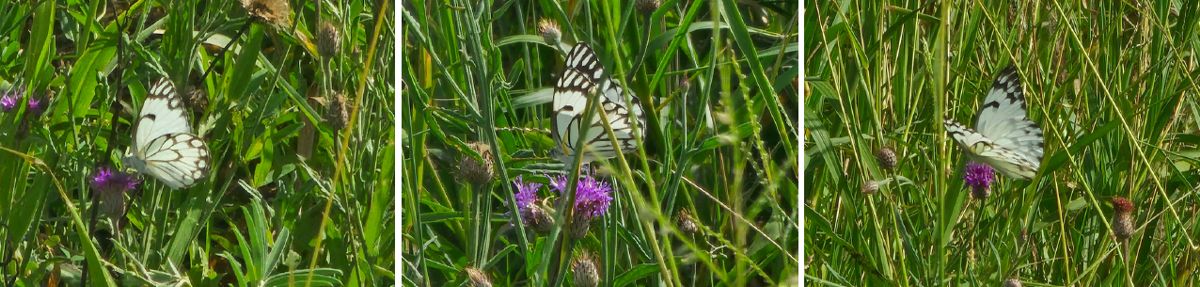
Words by Tess Woollgar. Images courtesy of Tessa Woolgar