


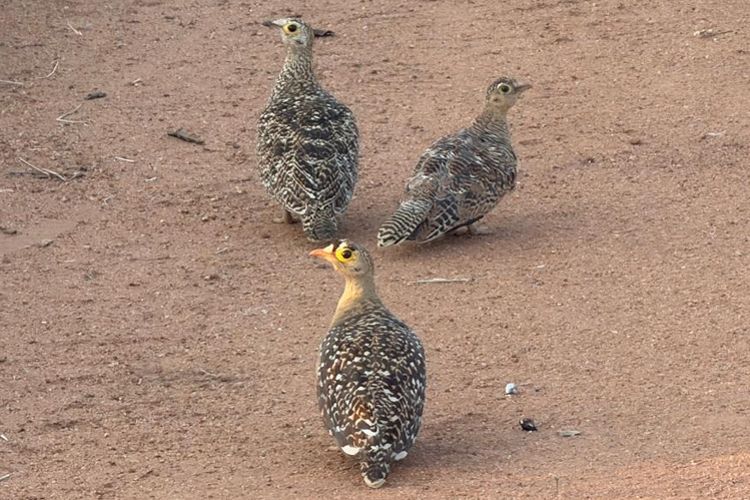
This beautiful bird (Pterocles bicinctus) is most commonly seen resting on gravel roads, using brilliant camouflage to remain hidden in plain sight.
With a staunch attitude towards freezing in the face of danger, this species may sit completely still until it feels the need to suddenly flee, bursting into flight at the last moment, and often causing quite a fright for the approaching party!
Known to prefer Mopane woodland, this is one of the more common bird species to encounter at Ingwelala, but they may also be seen in areas of mixed woodland, wooded savanna and rocky areas with gravel plains. Although mostly seen in pairs or small family groups, these birds have been known to flock in groups, especially at waterholes at dawn or dusk, when the birds congregate to drink water.
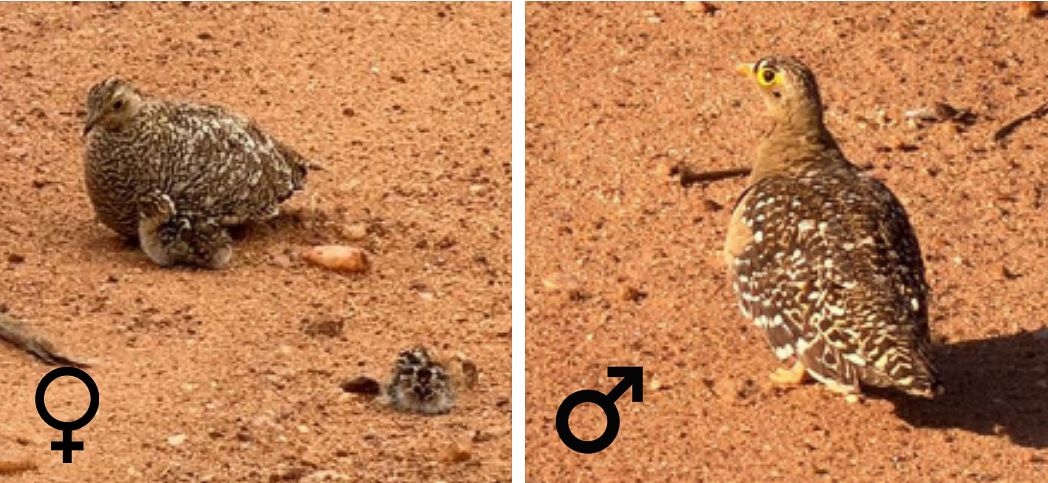
Adults show sexual dimorphism, with males and females having different colourations and markings. Males have distinctive black-and-white neck rings and foreheads, and plain chestnut-brown necks and chests, which females lack. Females are barred all over the body. Young chicks more closely resemble a fluffy baby tortoise, with large dark spots with white blotches in-between! See the close-up image of a chick, and of two chicks resting, circled on the image of the road.
Be careful when driving: animals have right of way - even the tiny ones!
Did you know?
- There is very little known about the development and care of young in the wild for this species. From observing birds raised in captivity, it was discovered that both the male and female incubate the eggs, and that incubation lasts under one month. It was also discovered that a chick could fly by less than one month old and had full adult plumage by between three and six months old.
- Even though these birds display healthy populations in protected areas, there is almost no available data on breeding success in the wild! However, it is known that males will dip their chest feathers into water, soaking water into the specially adapted feathers, which can hold moisture, and which he can fly back to his flightless chicks for them to drink.
Fun Fact:
- There are two different subspecies of Double-banded Sandgrouse that occur in southern Africa, and three in Africa - all of which differ in size and colouration. The more common subspecies in South Africa is known as subspecies P. b. bicinctus and is what would be described in most birding applications or books. The less common subspecies, P. b. multicolor - with more richly rufous coloured plumage - can be either larger or smaller than the more common subspecies, depending on distribution, and whether the population is east or west of the “common” range.


Click here for more on the Double banded Sandgrouse
Words by Tess Woollgar. Images courtesy of Jonathan Fleet and Josh Hibbett.