


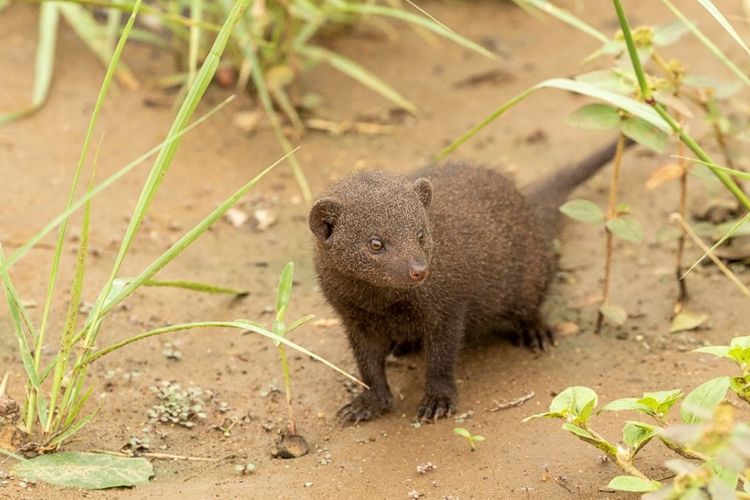
The cohesive groups of dwarf mongooses (Helogale parvula), Africa’s smallest carnivore, have been very active on Ingwelala this summer.
The adult dwarf mongoose measures about 38 centimetres tip to tip and has a mean weight of 270 grammes. Its coat colour is dark brown with lighter flecks on the hair strands. Eye colour is orange-brown. Preferred habitat is dry open woodland and grasslands where termitaria are found. The feet each have five digits with hardy claws adapted for digging and scratching in the sub-strate litter.
Dwarf mongooses are diurnal, living in social groups of up to 30 individuals. Old termite mounds are commonly used as overnight shelters and where young are raised. Rank order is important in their society where the dominant male and female form the alpha pair. The alpha pair will dominate the breeding in the group.
Whilst out foraging for food, dwarf mongooses remain in communication with each other uttering twitters. When danger is detected the alarm call is best described as a shrill chuckwee, using different alarm calls for different predators to heighten their senses from where the danger may come. In between avoiding predators, diet consists of beetles, larvae, insects, small reptiles, scorpions, lizards, eggs, and rodents.
Breeding takes place from October to April, gestation is around 53 days, pups are weened at 10 weeks, and all individuals in the group assist rearing the pups. Several litters are raised during the breeding season. Non pregnant subordinate females also lactate to feed the pups. Sexual maturity is reached at one year of age.
Dwarf mongooses are known to have special relationships with two bird species, namely Hornbills and the Fork-tailed Drongo. In the case of Hornbills, a mutualistic relationship occurs, whereby both species keep a look out for pending danger and warn each other of any potential threat. Where the Fork-tailed Drongo is concerned, a relationship of kleptoparasitism occurs. In this case, the Drongo being a master of mimic, sounds the dwarf mongoose alarm call when it sees a dwarf mongoose find food. The dwarf mongoose abandons its meal, thus providing the Drongo and opportunity to seize its meal!
Birds of prey, jackals, snakes, and larger mongoose species predate on dwarf mongooses.
Dwarf mongooses have excellent eyesight to detect predators.
Cheek and anal glands, found in both sexes, serve to mark territories and group members. The alpha male scent marks every individual in the group so he can recognise each individual, as intruders from other groups are not tolerated in the shelters and refuges. Several refuges occur within the highly defended territory. Dwarf mongooses have been observed doing handstands to rub the anal gland in a downward motion against vertical objects for scent marking purposes.
More interesting facts about dwarf mongooses:
- The Xitsonga name is maxindyani, in Afrikaans it is called dwerfmuishond.
- Rock crevices and fallen tree logs are also used as refuges and shelters.
- The dominant alpha female usually kills the young produced by subordinate females.
- Oestrus cycles are 1 to 7 days.
- Longevity in the wild: 10 years for males, 14 years for females.
- Tooth patter and shape assist to crush tough insect exoskeletons.
- IUCN Red List lists the conservation status as Least Concern.
- Scientific Order and Family classification is:
Order: Carnivora
Family: Herpestidae - A mutualistic relationship exists with Giant Plated Lizards which assist keeping dens clean by ingesting the mongooses’ faeces, in return the lizards’ benefit from easy found nutrients.

Dwarf mongooses utilize old termite mounds for shelter
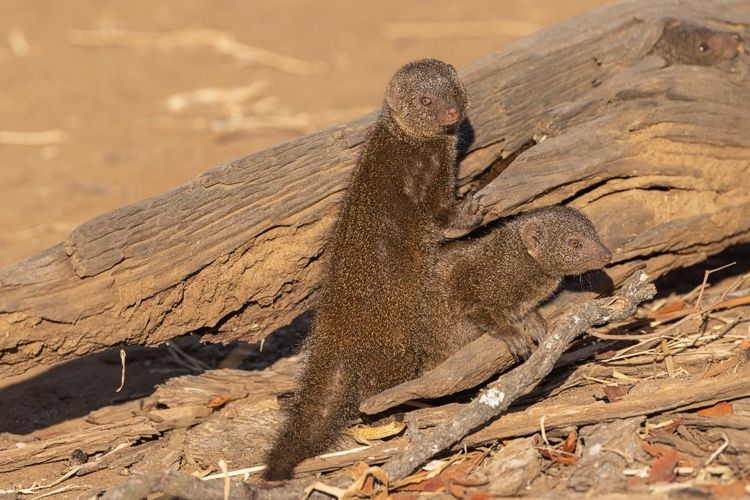
Sun basking early morning

Mutual grooming
Facts researched on the Internet. Words by John Llewellyn. Pictures courtesy Viv Newell.