


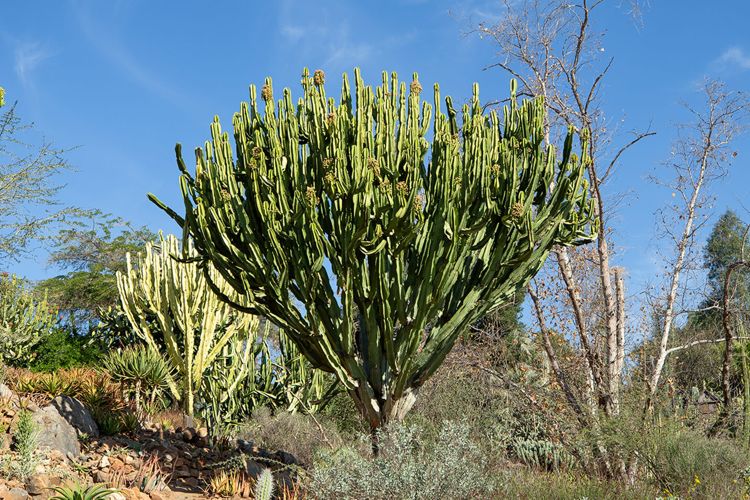
Chris Thorpe (an Ingwelala Member) very kindly drafted the text below to explain the identification and distinction between Euphorbia and cactus plants.
Simple method of differentiating the following species:
Indigenous:
- Naboom or Common Tree Euphorbia (Euphorbia ingens)
- Lowveld Candelabra (Euphorbia cooperii)
Exotic cactus:
- Queen of the Night (Cereus jamacaru)
The following identifying features distinguishes the two indigenous tree Euphorbia from the Queen of the night cactus.
Using most of the tree guides does not make for quick and easy identification so this is being written to simplify the identification process.
The following identifying features distinguishes the two indigenous tree Euphorbia from the Queen of the night cactus.
- White milky latex: All Euphorbia contain a toxic white milky latex whilst the Queen of the night cactus has no latex. So, if you are not sure a quick prick with a stick will solve that!
- Growth Form: The two tree euphorbias have a central stem/trunk, and the branches all grow in a candelabra like shape, with wide curving branches that start horizontally and then curve upwards.
- Naboom/Common Tree Euphorbia (E.ingens) is much larger than Lowveld Candelabra (E.cooperii).
The Queen of the Night (Cereus jamacaru) on the other hand does not have any substantial central trunk. Each stem grows straight out of the ground and vertically upwards or there is a very short trunk with vertical branches.
- Spines (spikes/thorns). This is the easiest identification feature:
In all three species the protective spines are in clusters or tufts/nodes up the edges of each branch but:
- Naboom/Common Tree Euphorbia (E.ingens) the spines are not visible, as they are very small (only about 2mm long). They are also in pairs hidden in brown tufts. There is no grey horny ridge like Lowveld Candelabra (E.cooperii) joining all the spinal nodes. The area between the nodes is green and fleshy.
- Lowveld Candelabra (E.cooperii) the spines are curved and about 8mm long, arranged in pairs on each node. These spines are clearly visible. Lowveld Candelabra (E.cooperii) has prominent grey horny ridges running up the edges of the branch edges in a continuous strip between all the spines (thorns).
- Queen of the Night (Cereus jamacaru) has very long straight spines (thorns) in clusters up to 250mm long.
Naboom/Common Tree Euphorbia (E.ingens) (Indigenous)
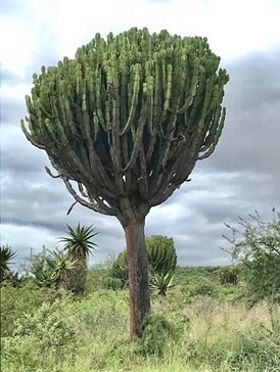
Naboom/Common Tree Euphorbia (E.ingens) The large tree form (picture taken opposite Tiezers butchery Ohrigstad)
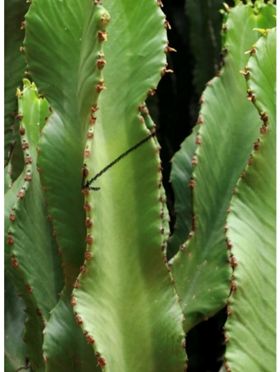
Euphorbia close up. Note that there is no grey horny ridge between the spines. The small pairs of spines are not visible as in Lowveld Candelabra (E.cooperii).
Lowveld Candelabra (E.cooperii). (Indigenous)

Lowveld Candelabra (E.cooperii). Note the typical upwards curved “candelabra” growth form which is typical of both Euphorbia and Lowveld Candelabra. (Picture taken next to Duke’s bungalow River Camp.)
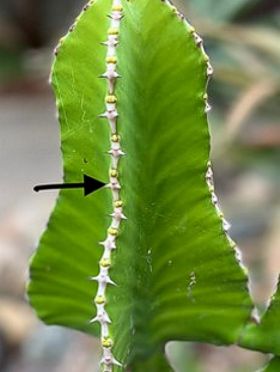
Lowveld Candelabra: Note the grey horny ridge clearly visible at a distance and paired spines which are only visible on Lowveld Candelabra and not on Euphorbia
Queen of the Night (Cereus jamacaru). (Exotic)
This is an invasive exotic cactus with fleshly vertical “stems” and in addition does not have a typical tree form. It does not contain the white latex that is a feature of all indigenous Euphorbia species. It has very long straight spines/thorns in clusters

Queen of the night (Cereus jamacaru): Note the vertical stems
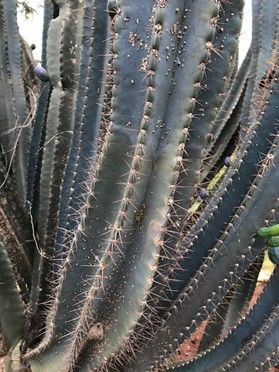
Queen of the night: Close up. Note the very long thin straight spines/thorns up to 25mm long, in clusters
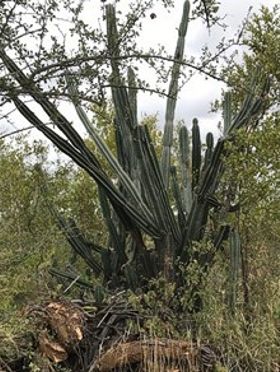
Large specimen of Queen of the night: Note the tall straight stems
Text and pictures by Chris Thorpe.