


Often there is commentary from interested bird watchers regarding the name changes to birds by taxonomists, just when you feel confident about a bird identification and name, the name is changed! For example, questions are asked of the difference between Francolins and Spurfowls, between Louries and Turacos, to name but a few of the species.
For example, questions are asked of the difference between Francolins and Spurfowls, between Louries and Turacos, to name but a few of the species.
Lapwings and Plovers are prime examples in the topic under discussion. These waders are part of the Family Charadriidae, of which there are 10 genera and 68 species.
So what is the primary difference between the Lapwing and the Plover?
The Lapwings have broad, rounded wings, whereas the Plovers have pointed wings.
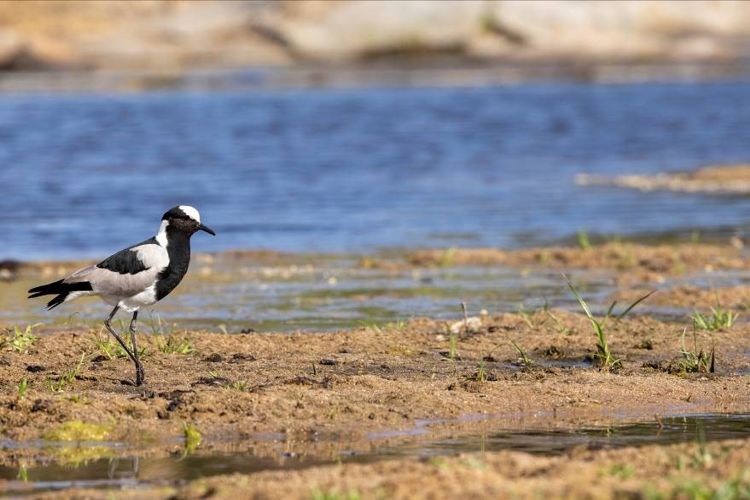
The Blacksmith Lapwing (Vanellus armatus) is a common Lapwing well known to many birders. It is easily identified through its bold coloured plumage of black, white, and grey. The eye is red, and the bare parts are dark grey to black.
Blacksmith Lapwings can be either sedentary or migratory, depending on preferred water levels and availability of food. It is diurnal, foraging during daylight hours, and can be single, in pairs or small flocks. They are found near water bodies and marshes and classified as waders.
The diet consists of worms, insects, crustaceans, invertebrates, larvae, ants, beetles, and butterflies.
Blacksmith Lapwings are territorial breeders. The breeding pairs are monogamous in nature. The female lays between 1 to 4 eggs which take between 26 to 33 days to hatch. Nests are shallow scrapes in the surface. The male and female share duties incubating the eggs. Chicks are fledged after approximately 40 days.
Blacksmith Lapwings are fiercely protective over their nests and young. They are equipped with a wing spur on the leading edge of both wings which is suitable armour to fend off any intruders, through repeated dive bombing from the air.
Blacksmith Lapwings are noisy birds, especially when alarm calling. Their characteristic “tink-tink-tink” sound gave rise to their common name which resembles a working blacksmith’s hammer striking the anvil.
The IUCN conservation status is of Least Concern (LC).
The Three Banded Plover (Charadrius tricollaris) is a small wader. Its back, wings and crown are brown in colour. The underparts and face are white. It derives its name from the distinct double black breast band.
Diet consists of terrestrial and aquatic invertebrates.
When water levels and food supplies are sufficient, Three Banded Plovers can breed throughout the year. Females lay two eggs near the water’s edge both the male and female incubate the eggs which hatch after 28 days. Fledging is at 30 days.
The IUCN conservation status is of Least Concern (LC).
The African Wattled Lapwing (Vanellus senegallus) is another conspicuous wader and easy to identify. It is the largest Lapwing in the Lowveld. The yellow wattles have red bases, the neck is streaked, the legs are bright yellow (and long), and the grown is dark with a lighter forehead.
The diet is made up of invertebrates and insects. African Wattled Lapwings are usually associated with water bodies but can also be found in inland areas, depending on environmental conditions.
It is one of the species to which the Agreement on the Conservation of African – Eurasian Migratory Waterbirds applies.
The White- crowned Lapwing (Vanellus albiceps) is best identified through the black and white wing pattern. It has longer yellow hanging yellow wattles than the African Wattled Lapwing, and the wattles are void of red bases. The centre crown and forehead are distinctly white.
Diet is invertebrates and small insects found close to water.
Pairs are monogamous breeders. Two to four eggs are laid in a shallow scraped hollow. Incubation is carried out by both male and female. Incubation is about 26 days. Nests and chicks are defended aggressively.
Due to habitat threat the conservation status of the White-crowned Lapwing in South Africa is Near Threatened.
The Crowned Lapwing (Vanellus coronatus) is identified though its black crown, divided by a white halo. Its brown and white colours with bright red legs further assist in its identification.
Habitat wise the Crowned Lapwing prefers the drier areas with short grasslands and in South Africa are more common in the semi-arid regions. The population is increasing due to advantages this species gains from human interventions and settlements. It is interesting to note that the Blacksmith Lapwing and the Crowned Lapwing show an amicable level of tolerance to each other where they co-exist. When establishing nesting sites the males of both species display certain body postures to determine hierarchy and rank.
During the breeding season the bare parts brighten. The breeding pairs mate for life. The male will attempt to lure the female to his territory, and it is the female who ultimately bears most of the incubation.
Diet is termites and insects.
Longevity has been recorded as long as 20 years.
Conservation status is of Least Concern.
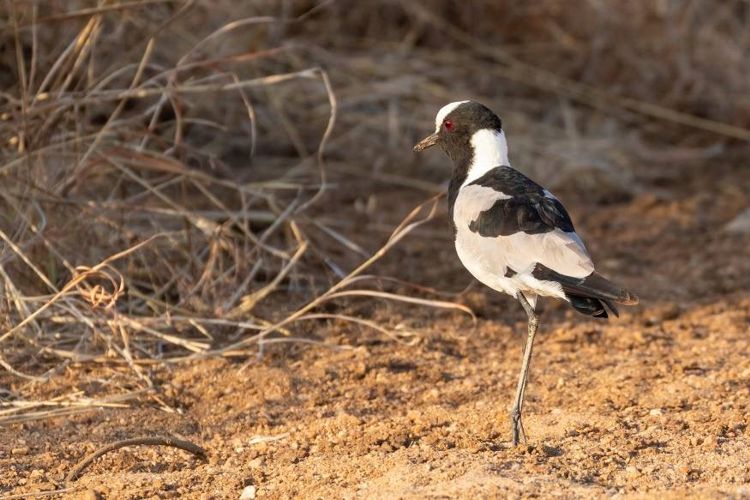
Blacksmith Lapwing
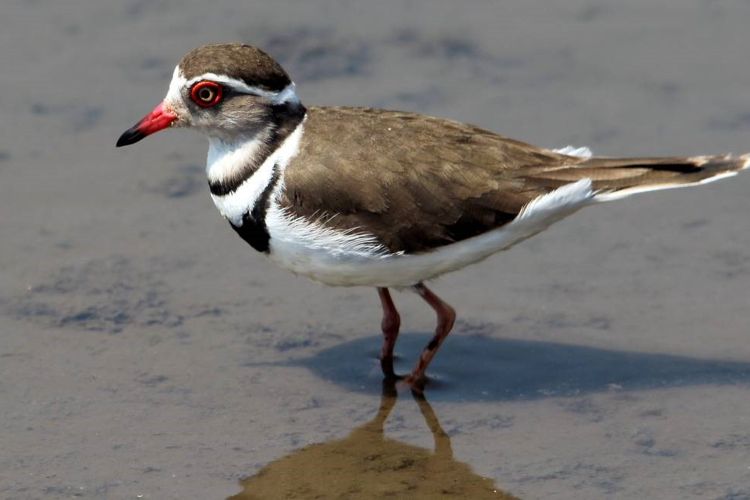
A Three Banded Plover with its distinctive colour pattern
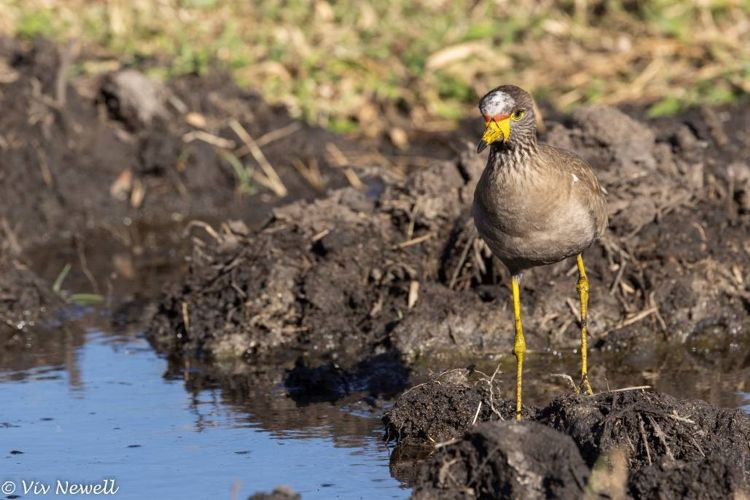
African Wattled Lapwing
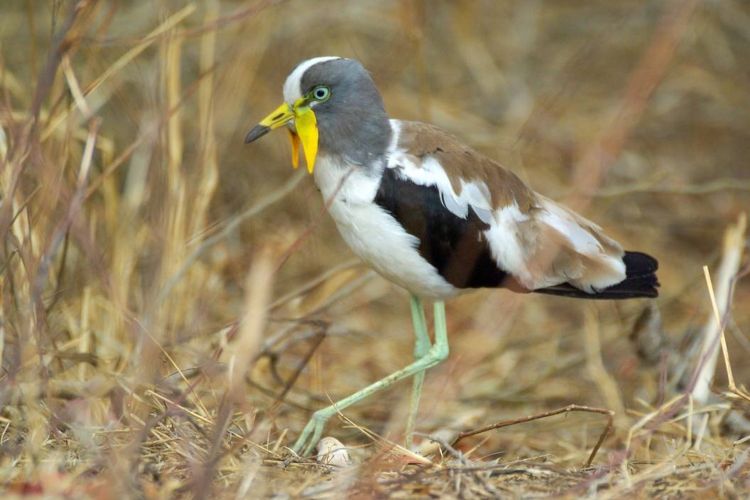
White-crowned Lapwing

Crowned Lapwing
Facts researched from the internet, text by John Llewellyn.
Pictures courtesy Viv Newell.