


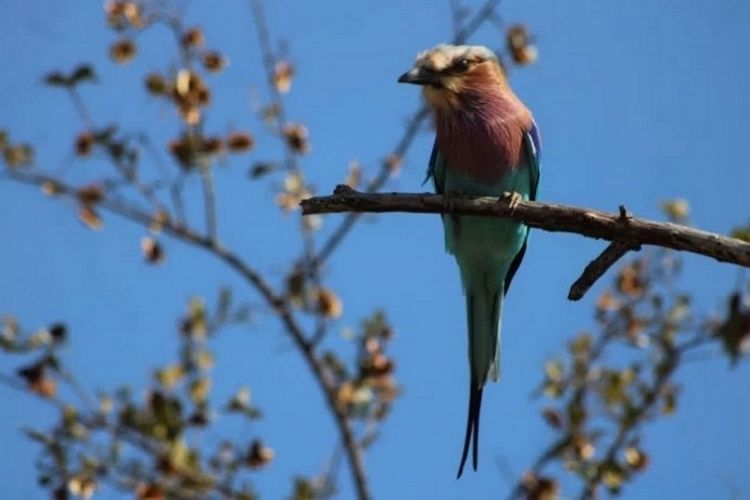
Africa’s most beautiful multi-colored bird. This common resident in the Greater Kruger might possibly even be the most photographed bird even though it is difficult to capture because of its active behaviour.
The Lilac-breasted Roller (Coracias caudatus) has around eight colours which very interestingly also represents the rich diversity and different tribes of Kenya making it their national bird. It is also known as the “Rainbow Roller”
It has yellow feet that have black tips and a turquoise tail ending in black. Part of the wings are reddish-brown with royal blue. The body is lilac (pale violet) with turquoise underparts. It has a green head, with a white chin and creamy white band around the black beak.
Official colours are therefore identified as:
- Green
- Black
- White
- Yellow
- Lilac
- Turquoise
- Dark blue
- Reddish-brown
Interesting facts:
- The Lilac-breasted Roller is not dimorphic, meaning it is difficult to distinguish between the male and female Roller.
- The Marabou Stork and Lilac-breasted Roller surprisingly have one thing in common; both linger around newly burned fields foraging on insects, chameleons, scorpions, and other small invertebrates or arthropods.
- These birds are known to suddenly fly down on their prey from their perches, fearless of moving vehicles and even humans.
Location:
The Lilac-breasted Roller is seen throughout southern and eastern Africa. They are common in Namibia, Botswana, Zimbabwe, Kenya, and northeastern South Africa. They prefer open woodlands and savannas.
There are five Roller species in southern Africa:
- Lilac-breasted Roller.
- Purple Roller (largest roller).
- European Roller.
- Racket-tailed Roller.
- Broad-billed Roller.
The name Lilac-breasted Roller derives from its mating rituals:
Aerial mating stunts include flying up into the air about ten meters, then swooping down with its wings closed. Another stunt is rolling side-to-side whilst flying fast, and when the aerial stunts are seen as successful the two rollers will then mate in the air. Call sounds during the mating flights have been described as ‘raak’ or ‘zaak’.
These birds are monogamous meaning they mate for life. Both parents will take care of the plain white eggs, which will hatch after 22-24 days.
Size of the Lilac-breasted Roller:
- 36-38 cms long including the tail which can be 8-9 cms long.
- They have a wingspan of between 50-58 cms.
Average life expectancy:
Around 10 years in the wild, and longer in captivity. The predators of the Lilac-breasted Roller may include Bateleur, Wahlberg’s Eagle, and Red-necked Falcon.
Folklores:
- Some African cultures/tribes consider the Lilac-breasted Roller a symbol of peace, and kings would sacrifice it at the end of a war to celebrate success.
- Zulus would use ropes made from the feathers to test a young couple’s similarity. When a young couple wanted to get married, they had to be tied together with the feathery rope, testing if they could work together. If the rope breaks, they could not get married.
- Venda would make wedding rings from the bird’s feathers.
- The Afrikaners have traditionally used the feathers in their wedding dresses. The Afrikaners call this bird ‘Troupant’.
The monogamous relationship and beautiful colors of the Lilac-breasted Roller may have been the inspiration for the various marriage traditions and beliefs. This bird symbolizes the deep connections between love and marriage.

Facts researched on the Internet, words and pictures by Christine Wagner.