


A recent and rare sighting by one of our members at the Buffelsbed hide regarding hippo behaviour is the topic of this report, thanks to Jo Baard for delving a little deeper into the subject.
Mating systems and behavioural structure around mating in the animal kingdom: In particular the Hippopotamus amphibius.
Mating system refers to the general pattern by which males and females’ mate within a population or species. Mating systems as well as the factors that determine them are diverse and variable. The key to understand this variation is the fundamental idea that individuals behave to maximize their lifetime reproductive success and that males and females are subject to different selective pressures. In general, female mammals invest heavily in rearing a limited number of young during their lifetimes whereas males tend to maximize reproductive success by mating with as many females as possible to increase the number of offspring they sire.
A mating system is a way in which a group is structured in relation to sexual behaviour. The precise meaning depends upon the context. With respect to animals, the term describes which males and females’ mate under which circumstances. Recognised systems include monogamy, polygamy (which includes polygyny, polyandry, and polygynandry), and promiscuity, all of which lead to different mate choice outcomes and thus these systems affect how sexual selection works in the species which practice them.
We are in that time of year (October – November) where we are at the end of our dry season and the beginning of the rainy season and mostly observe mating and calving/lambing this time of the year.
Within the first week of November two beautiful sightings has been witnessed. Hippo mating at Buffelsbed Hide and the first Impala lamb was seen.
 I have decided that it will be interesting in sharing the findings of Hippos mating and the category they are classified within (Polygyny).
Polygyny (the most common polygamous mating system in vertebrates so far studied): One male has an exclusive relationship with two or more females. This is associated with one-male, multi-female group compositions.
This means that during the mating season one male hippo mates with multiple different female hippos within his social group or environment. The mating process of Hippos does not happen as often as we would think. If we think of it, how often does one see any mating in the wildlife realm. We only see the aftermath of this process which is when the young are already born.
Mating only happens every two years in Hippo. This period places them in a group known as “k-strategists”, which is a group of large mammals that only reproduce after long periods of time. There is no specific season for mating, however, a pattern has been observed in some areas which indicate that they usually mate near the end of the dry season and the beginning of the rainy season. At this time the rain has brought them a lot of water and food which are ideal conditions for mating and eventually giving birth.
Dominant bulls gauge a females oestrus cycle by taste-testing the urine of cows by collecting and testing it with their muzzles. This takes place in the water, with the cow turning her hindquarters toward the approaching bull. (NOTE: the Flehmen grimace does not take place among hippo).
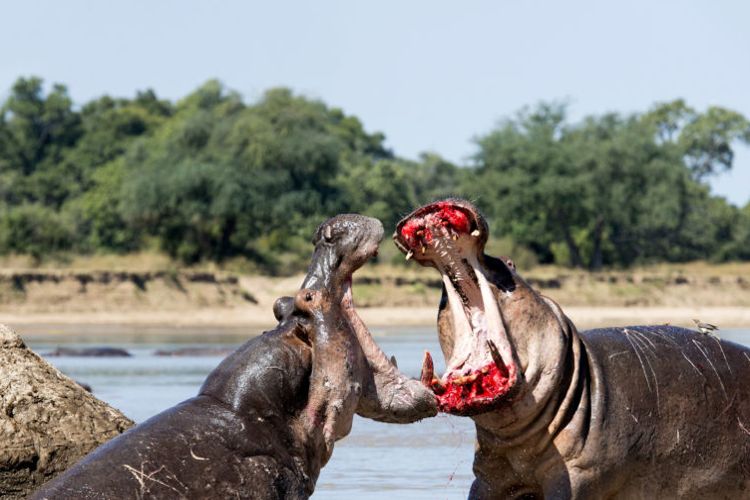 This build-up period is normally very intense and the males in the herd usually get very aggressive towards each other with severe fights between them, during which females could be caught in between. Hippos are probably not the most romantic and have little tact when it comes to mating as they try to attract a female.
During the peak period of attracting females, the male hippo urinates and defecate at the same time, spreading it with his tail in a rapid fanning motion, as a show of dominance. The bull will also spread its urine and faeces in the direction of the female it wants to mate with to get her attention. The mating process is usually marked as a period of aggression and trying to pick a female can last up to three days. After this, the mating occurs and generally takes place in the water.
There is no courtship, and the female is generally chased through the water and the females are forcibly submerged in the water by the male for the mating progress. Her head comes up in intervals for breathing.
Gestation is normally 225 – 257 (8 months) and the calf and mother have a very strong relationship from birth.
Facts and images researched off the Internet. Words by Jo Baard.