


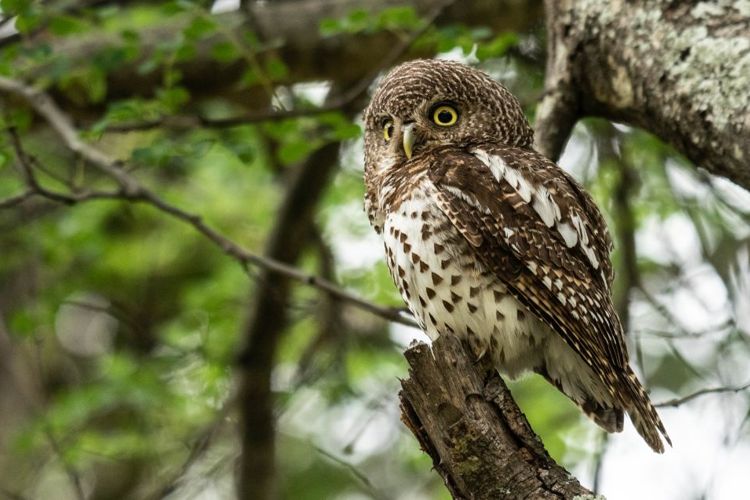
Owls possess a unique digestive system. Unlike most other bird species, owls do not have the digestive organ known as a “crop”.
The crop is an extended muscular pouch or portion of the oesophagus which birds use as temporary food storage, and this is where the process of digestion begins. When food is in the crop, it begins to soften and break down, making subsequent digestion easier. Having a crop also allows birds to consume food quickly, storing it in the crop for digestion later, and reducing the time spent in vulnerable positions while feeding.
The presence of a crop is largely linked to lifestyle: scavengers must gorge themselves on food when it is readily available, while seedeaters use the crop to soften and store food before further digestion, and to feed chicks with crop milk - a broken-down, nutritious form of the hard seeds and other foods ingested. Interestingly, most eagles, hawks, and buzzards possess a crop - but owls do not. These raptors can digest most bones and other hard materials, which owls cannot. This is due to differences in the digestive tracts, including the presence of the crop, and stronger stomach acid concentrations.
Being highly specialised and mostly nocturnal predators, most of the owl’s adaptations are trade-offs for silent flight and efficient hunting - especially at night. Owls must be fast-moving, hunt silently, be able to fly incredibly well and with immense accuracy, and consume their prey quickly - as they largely hunt by landing on prey on the ground, putting them at risk of predation, and of losing their hard-earned prey. To achieve this, owls must be light-weight and aerodynamic. They also need to be able to digest food quickly and avoid having excess food weight stored internally or carried with them in their talons. To achieve this, owls do not have a crop and must swallow their food whole as much as they can. In this way, owls can catch and eat their prey in split seconds and then move to safety quickly and quietly to begin digestion.
Like other birds, owls have two stomachs: the proventriculus (glandular stomach) and the ventriculus or “gizzard” (muscular stomach). The first stomach is responsible for chemical digestion and produces mucus, acids and enzymes, that begin digesting and softening food. The second stomach is muscular, for physical digestion, and uses muscles to loosen soft materials from hard materials, allowing soft materials to pass further along the digestive tract for absorption. The second stomach also serves as a “filter” in some birds of prey, trapping materials such as fur or bones that cannot be digested, compacting them together for regurgitation.
Because owls cannot digest hard materials, the owl’s digestive system is designed to separate soft tissues, such as muscle and soft internal organs, from hard tissues, such as bones, claws, beaks, teeth, feathers and fur. Soft tissues are passed through the digestive tract, broken down, and absorbed. However, the hard tissues cannot be broken down - so they must come back up! This results in owl pellets - small, dark, odourless pellets, regurgitated after every meal, and often confused with the excrement of mammals. Owls can also digest foods relatively quickly, as their digestive system does not need to digest the hard materials that will be regurgitated.
Although some other birds of prey also produce pellets, the consistency is different. Other raptors can digest most hard materials, so if pellets are produced, they often only consist of balls of fur, and much less food residue. They are generally also not regurgitated regularly. Because owls cannot digest any hard materials, all must be regurgitated to avoid blocking the digestive system. Owls physically cannot eat more unless the pellet has been cleared, and as such will regurgitate a pellet every few hours to continue eating. The pellets include fur, all bones, and anything else that could not be digested. This is high food residue, as it is possible to identify exactly what has been eaten by examining the pellets. Full skeletons can be extracted from these pellets to identify what prey species the owl has been feeding on, and they therefore provide an excellent research tool.
Depending on the size of the owl, and the size of the prey, owl pellets can either contain one full meal, or multiple small meals. A Western Barn Owl, for example, may feed on multiple small rodents throughout the night. When the ventriculus is full, all hard materials are compacted together, and one pellet is regurgitated containing multiple skeletons. However, if a larger meal is ingested, the owl will not feed again and will regurgitate one pellet from that singular, larger meal. Usually, a pellet is regurgitated every ten hours or so. These pellets often accumulate below a favoured perch and serve as a good indicator of where to look for owls.
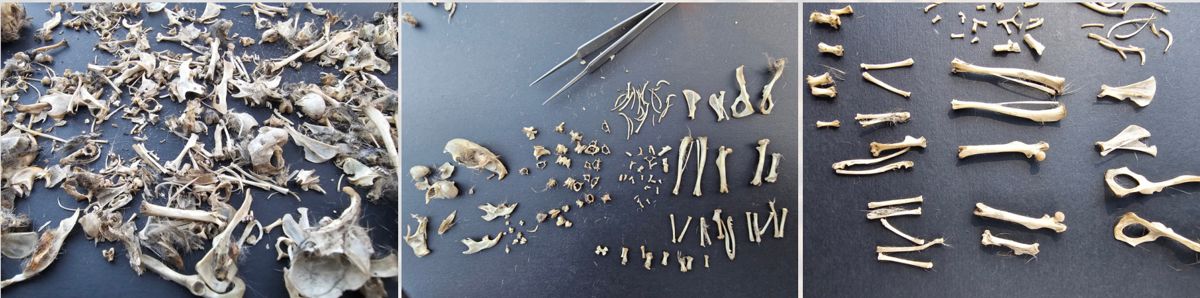
Using pellets, it is possible to determine what owls are eating, potentially how frequently, and even assist with biodiversity surveys and specialised studies in owls and/or rodents. Please see the below images of an accumulation of owl pellets at a roosting site, a close-up view of a single pellet with the bones and teeth of prey species visible, and the dissected contents of owl pellets (five-rand coin and fine dissection forceps for scale). The contents of these pellets revealed a largely rodent-based diet, the majority of which were tree squirrels of a similar size.



Words by Tess Woollgar. Images courtesy of Ingrid Passier and Tess Woollgar.