


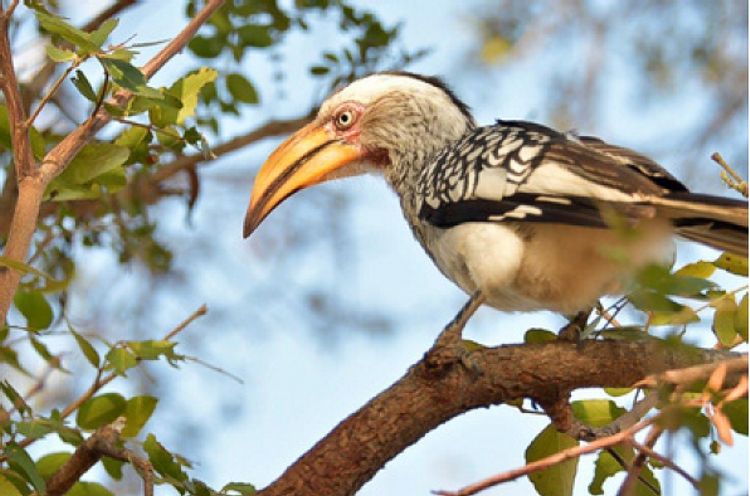
As one of the most common bird species to encounter at Ingwelala, the Southern Yellow-billed Hornbill is a species that almost always delivers an entertaining, close-up sighting in the bush.
With a large, curved yellow bill and long eyelashes, this bird has a distinctive look that captures your attention almost immediately.
With black and white plumage, and reddish-pink facial skin, the distinguishing characteristic between this bird and the smaller Southern Red-billed Hornbill is all in the name - the colour of the bill. Males are larger than females, with slightly larger bills, and adults reach roughly 50cm, with a weight of 190g.
Southern Yellow-billed Hornbills are omnivorous, feeding on insects, invertebrates, small mammals, reptiles, fruits, seeds and other plant matter. They are also known to pick apart buffalo and elephant dung to scavenge for insects or undigested plant material.
Did you know?
Southern Yellow-billed Hornbills have a very unusual strategy when nesting. The female will seal herself in the hollow of a tree cavity, and after a few days she lays eggs one at a time, usually at two-to-three-day intervals. The female moults her tail and flight feathers, using them to line the nest after the first egg is laid.
The chicks hatch at different times, and when her tail and flight feathers have grown back, the female will emerge from the nest. The chicks reseal the nest entrance and only emerge after another 20 or so days. During the time when the entrance is sealed, the male feeds the female and chicks through a small slit left open in the seal, and excrement is dropped out by the female and chicks during the nestling period.
Because of this unusual strategy, it is a risk to the family should the male die during the nestling period, as the male is solely responsible for feeding the growing family, while the female, having moulted her tail and flight feathers, is rendered unable to fend for herself.
Fun Facts:
- This species has a mutualism with Dwarf Mongooses. The hornbills catch and eat food flushed out by mongooses digging and feeding nearby, while the mongooses are alerted to the presence of predators by the hornbills as they stand watch around the gang. Young mongoose pups have also been known to practice their fight or flight reflexes with hornbills, “playing dead” in an entertaining game as the hornbills hop around them looking for food.
- Hornbills practice “anting”, during which they lie very still on the ground allowing ants to climb all over them and clean any impurities, insects or pests off their bodies and feathers.

Words by Tess Woollgar. Images courtesy of Maureen Kirk