


One of my favourite reports so far to write. To confine a story and passion to two pages is difficult to do when one is so passionate about a certain species. But here we go:
South Africa is home to two sub-species or races of honeybees which are indigenous to the country: Apis mellifera scutellate (African Honeybee) and Apis mellifera capensis (Cape Honeybee).
The African honeybee subspecies (Apis mellifera scutellata) is native to central and most of southern Africa. The African honeybee is one of two sub-species of honeybees in South Africa – the other being the Cape honeybee (A. m. capensis), which is found in the winter rainfall area, generally confined to the Western and Southern Cape regions. A hybrid zone between the two regions divides the two subspecies with the African honeybee covering the region to the North of South Africa further extending into East Africa.
Honeybees play an important role in human lives as they are managed by beekeepers to allow for honey harvesting and to provide a pollination service to farmers of pollinator-dependent crops. Humans have been keeping honeybees for thousands of years, yet we are continuously learning about them. Recent reports of massive honeybee losses across the world have helped encourage public interest in the honeybee and the flower resources the honeybee needs for survival.
Fun facts about honeybees:
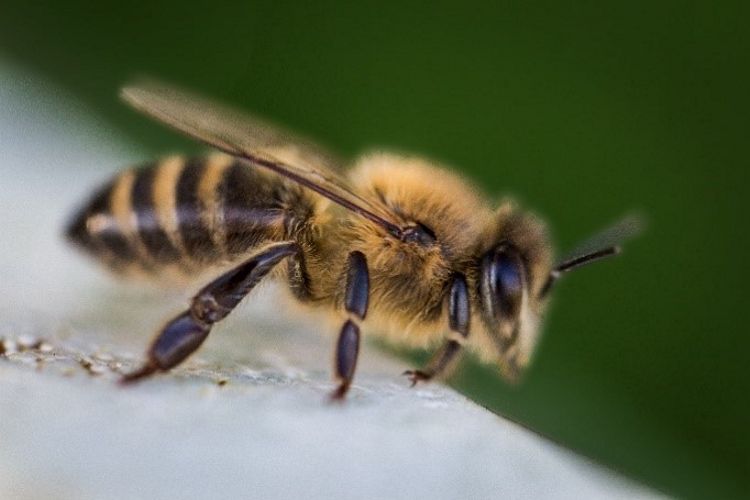
- Bees have five eyes (two compound eyes and three single lens eyes) and a worker bee’s main eyes have nearly 7000 lenses.
- An electrostatic charge on the bee’s hairs attracts pollen and the leg brushes, then scrapes, the pollen from front to back, where it collects in the pollen basket – a wide, flat area on the rear pair of legs.
- The proboscis (long tongue) is an airtight, straw-like tube that sucks up nectar and also works in reverse to feed offspring from the honey stomach.
The African honeybee is an aggressive bee with a hardy strain and capable of producing large crops of honey. It is said, the more aggressive the bee, the more honey is produced.
The honeybee lifecycle includes egg, larva, pupa, and adult stages. Honeybee colonies comprise of a single mated queen and 10 000 to 50 000 of her worker daughters. The queen can choose the sex of her offspring because of haplodiploidy (the sex-determination system of bees, wasps and other Hymenoptera). Diploid eggs are fertilised and produce female offspring (workers and queens), while unfertilised, haploid eggs develop as males (drones).
In order to mate, a queen flies with drone aggregations on one to four successive afternoons, mating with six to ten males on each flight. The average lifespan of a queen is three to four years; drones usually die upon mating or are expelled from the hive before the winter; and workers may live for a few weeks in the summer and several months in areas with an extended winter.
The honeybee is a social insect feeding on pollen and nectar of flowering plants, while at the same time providing the essential service of transferring pollen from one flower to another – thereby facilitating pollination and the reproduction of flowering plants. The African honeybee is an important pollinator of flowering plants, including many of our thorn trees. Honeybees are used to pollinate about 50 crops across South Africa, including sunflower seeds and subtropical fruit found in the northern region of South Africa. Imagine your world without all the fruits and vegetables we rely on for a healthy diet!
 In healthy colonies the brood combs usually have a compact pattern. Almost all the cells from the centre of the comb outwards contain either eggs, larvae, or pupa. Capping’s are convex and tend to have a uniform colour. Unhealthy brood combs of diseased colonies often have spotted pattern combs. The capping’s may appear sunken or even punctured and the colour can be darker.
The African honeybee is not officially classified as Threatened; however, they are experiencing threats, including diminishing forage resources, pests, and diseases, as well as problems arising from the misuse of pesticides and insecticides in the environment. South Africa also has a unique problem in that the Cape honeybee (A. m. capensis) can become a social parasite if introduced in the other subspecies’ (A. m. scutellata) range. To remedy this, a dividing line has been drawn to separate the area in which (A. m. scutellate) and (A. m. capensis) can be used for beekeeping activities and no bees may be transported across the demarcation line.
Special Notice and request from Jo and Wallie:
If any Ingwelala Members have any bees in or close to their bungalows that you would like to have removed, please call Jo and Wallie and we will gladly remove and relocate them for you. It is our passion to conserve, study, and educate about bees, and spend time with our hives during our personal time-off, to be part of the greater good to conserve these intelligent species. Please do not poison the hive as bees are crucial to the ecology and it is a sad day when bees are needlessly destroyed.
Bees are responsible for the vast majority of pollination in the natural world, and it is interesting to note that in many polluted countries they have to do hand pollination in cultivated fields and fruit orchards due to the large losses of natural bee colonies, often caused by the irresponsible use of pesticides.
Text by Jo Baard.