


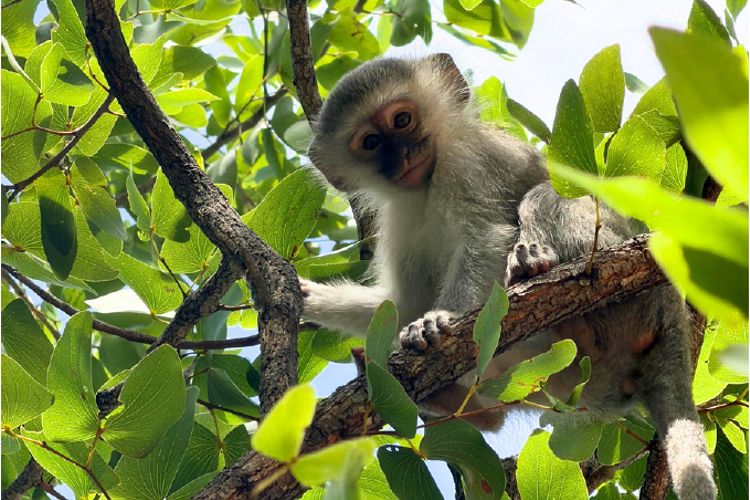
This small and resourceful monkey, (Chlorocebus pygerythrus), is found commonly throughout the lowveld.
It is largely considered to be one of the most encountered mammals in the bush and is known to be highly intelligent. Standing at a height of approximately 30cm, Vervet Monkeys can weigh up to 8kg and are powerful for their size. With complex social structures, and advanced problem-solving skills, this species is known to adapt quickly and readily to any situation - including capitalising on human-populated areas close to and within wilderness areas.
Feeding on a diverse variety of fruits, flowers, leaves, herbs, tree sap, eggs, insects and more, Vervet Monkeys will readily take any opportunity to scavenge between their usual daily foraging. They have an average lifespan of twelve years in the wild.
Did you know?
- Monkeys live in large troops of up to thirty individuals. Within the highly complex social structures of Vervet Monkeys, there may be several males present in each troop. However, there will always be a one dominant male within the troop. Male dominance enables mating rights, and this is determined by a combination of social status, age, experience, fighting ability, size and strength. Females, however, inherit their social status within the troop from their mothers. Social bonds are developed or strengthened by grooming and playing.
- Females within the troop may favour certain males, and when hierarchical battles ensue, they are not exclusive to males only! Females will readily get involved, defending the male they favour and actively “ganging up” on intruding, less dominant or unfavoured males, using a strategy of intimidation in numbers. This is also seen when two troops clash over favourable habitats, as is commonly seen in our reception area! Fights between males can be brutal, often injuring or even killing each other, and occasionally targeting youngsters within the troop as well. Young males in the troop may be of particular interest to dominant males.
Fun Fact:
- Vervet Monkeys don’t only use complex vocalisations to communicate - they also use body language! This is especially evident with facial expressions and body posture. By using their eyelids, lips and body posture, monkeys can communicate threats to each other. In this way, others can determine whether a monkey is in an aggressive or defensive position, and how to respond appropriately to each situation.
Words by Tess Woollgar. Images courtesy of Aimee Langenhoven.