


Amanda Skhosana reports on the Responsible Resource Use, a short three-day course that she and Zabe Zwane attended.
Introduction and Background
Zabe Zwane and I were enrolled at the Southern African Wildlife College as Ingwelala Share Block interns for this course. The course was originally scheduled to last five days, but it was modified and shortened to a three- day course. The purpose of this course was to educate students on the idea and fundamentals of responsible resource use, to foster critical thinking, and to encourage students to think about sustainable resource use from social, ecological, and economic perspectives.
Responsible resource use entails using resources in a morally responsible manner in order to preserve Africa's natural resources and promoting proactive measures to enhance the soil, water, and biodiversity. Sustainable growth requires careful management of natural resources. Sustainability depends on the following spheres described below.
Economic Sustainability
Economic sustainability refers to the ability to make choices that are both fair and financially responsible while also taking into account other sustainability factors. Economic sustainability entails adding value to your projects or entities from an economic perspective.
Social Sustainability
The foundation of social sustainability is the idea that an entity or project should work to improve society. In general, future generations ought to benefit from the same improvements in quality of life as the current generation does. Failure to prioritize social responsibility can cause the sustainability spheres to gradually collapse.
Ecological Sustainability
A true sustainable ecosystem would sustain populations, biodiversity, and general functionality over an extended period of time. The best course of action is to make choices that support natural system equilibrium and aim to foster development. Every effort should be made to prevent unnecessary environmental disruptions. If a disturbance occurs, it should be reduced as much as possible. The environmental implications of a planned end or result should always be discussed while making decisions.
It is possible to determine whether a company is on the verge of being sustainable through these spheres that assess its sustainability. Consequently, a sustainable company is the one that after being evaluated either maintained its prior level of development or encouraged operations to improve the level on the three spheres. The three sustainability spheres must harmoniously interact with one another in order for sustainability to exist. Without these three spheres, sustainability cannot exist. Each of the pillars demonstrate a setting in which sustainability is used, while also demonstrating their interdependence. This can be achieved while taking into account the four characteristics of Responsible Resource Use listed below.
- Holistic
- Inclusive
- Ethical
- Regenerative
Example: Ways in which Ingwelala can incorporate the ecological sphere of sustainability into the company:
- The Reserve can use clean energy. Clean energy (going “green”) entails relying on solar panels for energy, rather than on electricity or a generator as a source of energy.
- It may also consider using biogas, which is an environmentally friendly, a renewable energy source resulting from the breakdown of organic matter.
- It should consider upgrading its water reticulation system because water loss occurs from dated leaking pipes. Additionally, they can conserve water by flushing toilets with stored grey water, which is domestic wastewater produced in homes or offices from streams without fecal contamination.
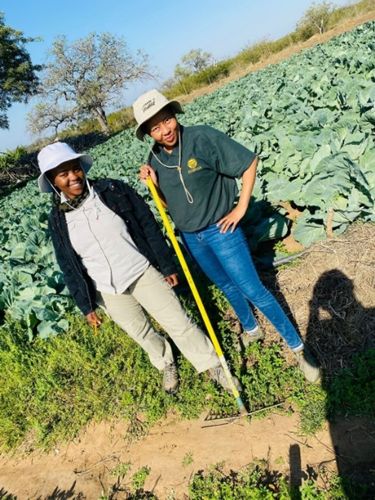
Zabe and Amanda during the course
by Amanda Skhosana