


October sightings, wildlife monitoring, and interesting research projects and observations.`
Sightings of the month!
Thank you to all who recorded their sightings in the book this month! There were 254 recorded sightings in the sightings book, with an average of 8.2 sightings recorded per day.
.
Listed below is the number of recorded sightings of a few species during the month:

Highlights:
- Elephants were the most recorded species for the month, closely followed by lions, leopards, buffaloes and wild dogs. Elephant sightings were diverse, ranging from sightings of lone bulls and groups of playful bulls to large breeding herds of 80+!
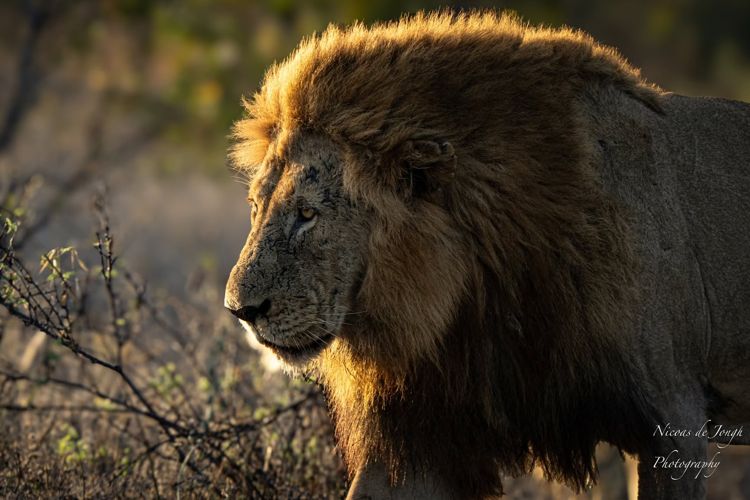
- Lion sightings were regular throughout the month, with two different mating pairs seen regularly, and various sightings of lionesses, and prides with cubs. Over a period of three days Members experienced a sighting of a pride of lions on a giraffe kill, while other Members witnessed a sighting of two lionesses killing an impala at Beacon Boma!
- Leopard highlights included a special sighting of a leopardess carrying a very young cub in her mouth at Timbavati Crossing, an older leopard cub stalking prey in the bush at Giraffe Gate, a mating pair of leopards at Zebra Pan, and a leopard who had her kill stolen by a hyena - during which she fell out of a tree in her haste to make an escape with the kill!
- There were four cheetah sightings during the month, all on Buffelsbed, including a sighting of a male and female in the same vicinity at Serengeti Plains.
- Other highlights included two caracal sightings, and a sighting of two hyenas swimming at Tamboti Crossing.
- Birding highlights included the return of European Bee-eaters on the 21st of the month, a sighting of two Greater Honeyguides at Bird Hide, a Tawny Eagle in a nest at Elephant Pan Hide and a sighting off a Long-billed Crombec in a nest. See Nature Notes below!
- The artificial nest box is also currently in use by a family of four Southern Ground Hornbills! Look out for updates in the coming months.
 Images courtesy of Josh Hibbett
- Mammalian species recorded: Cheetah, Leopard, Lion, Elephant, Buffalo, Wild Dog, Spotted Hyena, African Wild Cat, Caracal, Black-backed Jackal, Side-striped Jackal, Spotted Genet, Lesser Galago, Impala, Kudu, Blue Wildebeest, Giraffe, Zebra, Waterbuck, Warthog, Hippo, Nyala, Bushbuck, Klipspringer, Duiker, Steenbok, Chacma Baboon, Vervet Monkey, Springhare, Scrub Hare, Tree Squirrel, White-tailed Mongoose, Banded Mongoose, Slender Mongoose, and Dwarf Mongoose.
- Reptilian species recorded: Water Monitor, Black Mamba, Mozambique Spitting Cobra, Eastern Tiger Snake, Nile Crocodile, Flap-necked Chameleon, Leopard Tortoise, Marsh Terrapin, Rainbow Skink, Giant Plated Lizard, and Serrated Hinged Terrapin.
For the full list of bird species recorded during the month, please click here.
 Images courtesy of Caroline Culbert

 Images courtesy of Craig McCann
 Images courtesy of Auriel Thorpe & Frank Hurst

 Images courtesy of Maureen Kirk
 Images courtesy of Aimee Langenhoven
Nature Notes: Long-billed Crombec Nest
While conducting tree protection activities this month, a small flutter of movement nearby caught our attention. Nestled in the lower branches of a Terminalia was a tiny hanging, purse-shaped nest, gently swaying in the wind. Closely resembling the tangled web of a community spider’s nest, and similarly covered with vegetation and debris, this was immediately identified as a Crombec’s nest. With much excitement, we waited to see if there was any movement from within the nest. After a few minutes of waiting, with no Crombec in sight, we tentatively approached the nest and had a closer look - the perfect teaching opportunity for the intricacies of such a specialised and delicately constructed nest!
To our immense surprise, there were two minute, speckled eggs, safely tucked away and clearly visible from the entrance above. Realising that the nest was clearly occupied, we backed away and waited patiently once again - and to our delight, a Long-billed Crombec appeared only a few minutes later, happily settling into the nest as though we were not even there! With only the very tip of the head visible, we enjoyed watching this little Crombec as it happily incubated the brood, sitting as still as a statue, apart from the occasional blink, or look from side to side.
This joyous find was a lovely reminder of the smaller things - and how easily things can be overlooked in the bush. Had it not been for us being stationery at the base of a nearby tree, on foot, we would never have even known that the Crombec, or the impressively camouflaged nest, were even there! It has also presented the perfect opportunity to delve deeper into these incredibly crafted nests, the intricacies of Long-billed Crombec breeding strategies, and share a deep appreciation for something so immensely tiny, but so magical to see.
The Long-billed Crombec (Sylvietta rufescens) is a truly miniscule bird species occurring across most of southern Africa. At a maximum weight of 16g, but averaging around 11g, this is one of the smallest species that occurs at Ingwelala. In Afrikaans, the bird is known as a Bosveldstompstert - loosely translating to a “bushveld stump-tail”, referring to the substantially shorter tail in relation to the rest of the body.
Crombec’s produce one of the more unusual nests in the lowveld, as they do not construct a typical nest of messy twigs one usually associates with bird nests. Crombec nests take the shape of a hanging purse or bag, with the opening on the top, and are delicately constructed out of natural materials, and are carefully and intentionally camouflaged to blend into the surrounding environment.
 Images courtesy of Aimee Langenhoven
Amazingly, these nests are constructed over a period of only seven to ten days, in spring and summer, and are usually found hanging on lower branches of trees or shrubbery, usually a meter or so above the ground.
Using dry grass and silky plant fibres, the birds carefully weave the structural loop of the nest onto a branch, creating a tangled “knot” to support the nest. Then, the basic structure of the hanging bag nest is created in a similar fashion. The opening at the top of the nest is usually wide, with a reinforced lip on the outer edge for the adults to perch. Little is known about whether males or females build nests.
The entire nest is coated in spider webs, leaves and small chips of wood or other vegetation, to strenghthen the nest and camouflage it amongst the shrubbery - bearing a striking resemblance to community web spiders’ nests at a glance. This may be a strategy to avoid predation of the eggs and chicks.
Usually, only one to three eggs are laid, and the eggs are incubated by both parents. Interestingly, this species’ nest is often parasitised by the Klaas’s Cuckoo, whose eggs may match the host’s eggs almost perfectly, and the Cuckoo has been known to lay eggs to match those of each host species!
The brood parasite often removes the hosts’ egg(s) to make space for their own - so it is possible that the below image contains one Crombec egg, and one Cuckoo egg, as the cuckoo egg may be fractionally larger than the host’s!
 Images courtesy of Aimee Langenhoven
Words by Tess Woollgar. Images courtesy of the photographers as credited on photos or sets of photos.