


Winter has officially arrived in the Lowveld, however, looking at the veld condition one could be mistaken into thinking we were into the late summer months.
The grass sward remains dense and 80% of the woody layer has yet to shed its foliage, all are because of the extreme late rains of this past wet season. We are under no illusions as to the fire risk that is imminent once this grass sward dries off.
Weather for this June had us at a minimum of 1 degree Celsius with a maximum of 27 degrees Celsius. The rainfall recorded was 8mm.
Elephant presence along the camp fence remains high. It is once again pleasing to report that the elephants have yet to threaten or damage this infrastructure. This is now the 10th consecutive month without any breakages.
Firebreaks around the Members bungalows continued as the priority task, this work has now been fully completed. All Hides and Bomas as well as management housing and the office complex received attention as well.
River crossings were attended to as needed. Specifically, repairs were made to the concrete base on the western side of Wahlberg’s Crossing which had slowly deteriorated over the years. The western bank of Farmhouse Crossing will be attended to next.
The red water fern at the main causeway which has plagued us over the last few months was removed in its entirety, this will be monitored over the coming months.
Work is underway in the camp area to clear all roads and driveways from encroaching vegetation.
Buffalo Behaviour
An interesting activity noted during the reporting period is how the buffalo have been targeting the plant shrub Kalanchoe beharensis, also commonly known as elephant’s ear or velvet elephant ear or velvet leaf kalanchoe. This behaviour has not been observed with any great measure before. Of additional interest this season is the abundant flowering of the elephant’s ear. Insect interest in the flowers has been super intense.
Kalanchoe beharensis is a succulent (crassula) plant, it belongs to the family Crassulaceae and is a native plant to Madagascar. Some literature refers to the plant now being classified as indigenous to Africa.
The kalanchoe is a deciduous shrub, growing on average to about two meters tall on Ingwelala. The stems are spindly and ribbed. It is a hardy shrub that is both frost and drought resistant. This makes it a worthwhile garden plant. The velvet reference is due to the fine felt-like hairs found on the leaf surfaces.
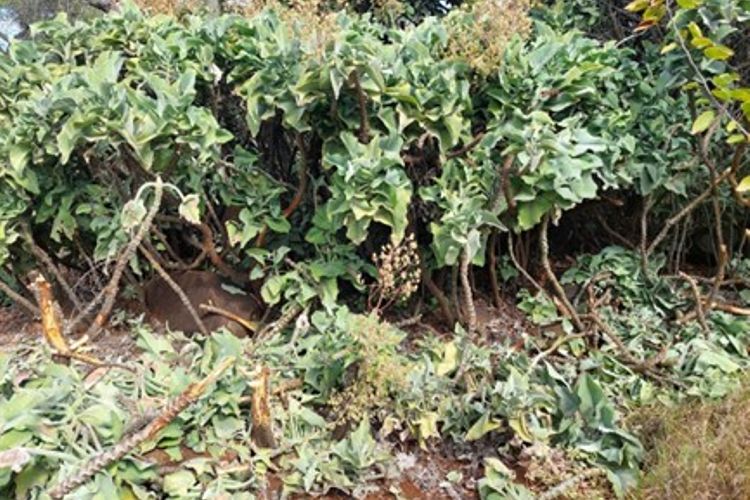
Kalanchoe beharensis
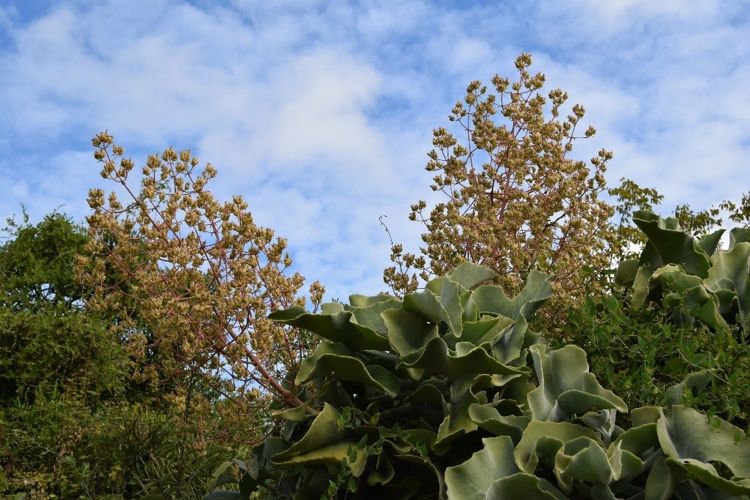
Prolific flowering of the kalanchoes this season
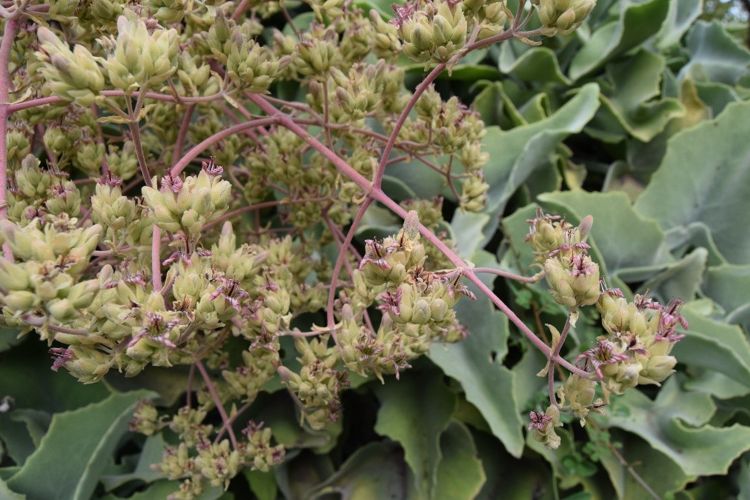
A close- up images of the flowers
by Chris Mayes; Intro Photo: Heitlé Booysen